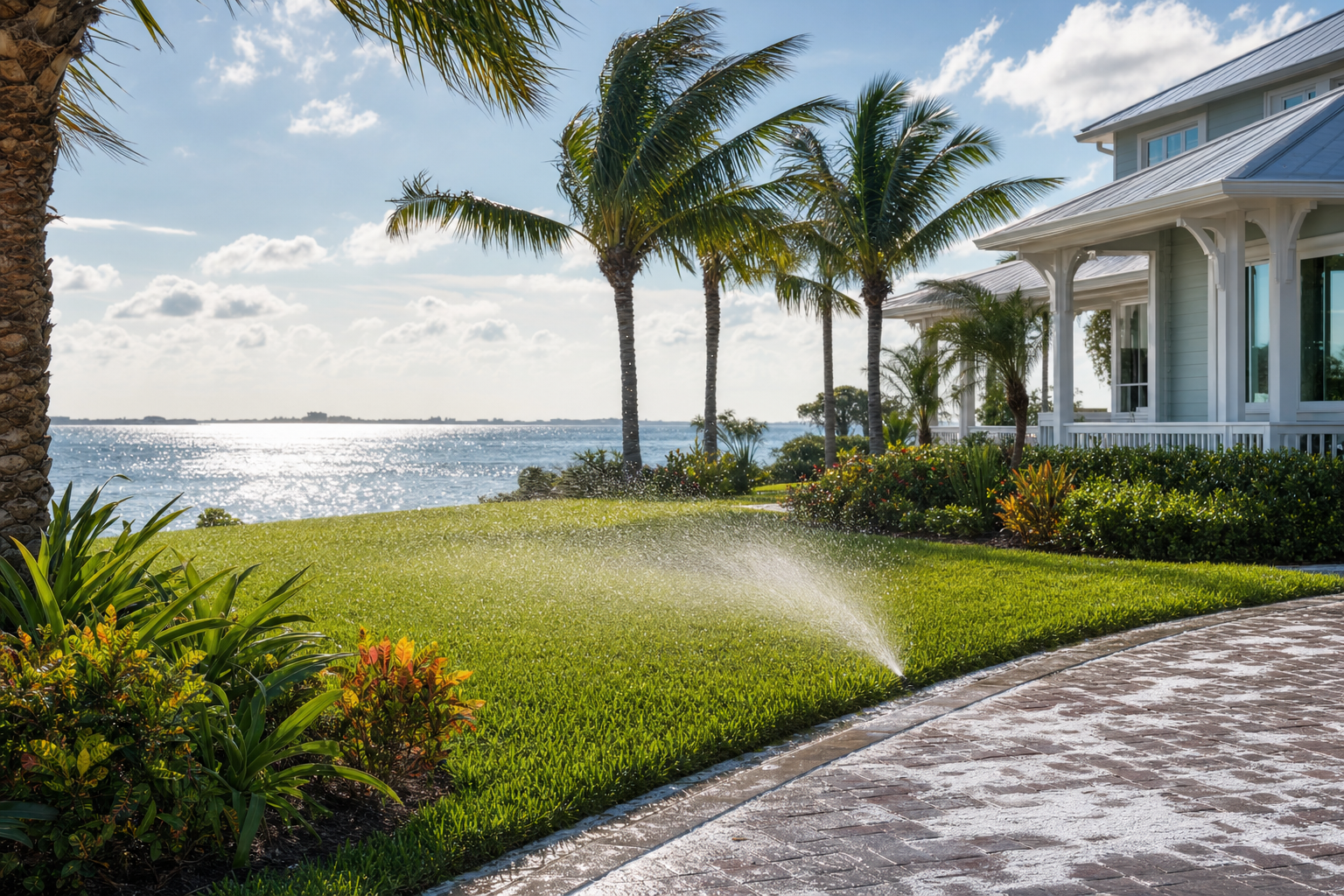
If you live on Longboat Key, Siesta Key, Bird Key, Casey Key, or any of Sarasota’s barrier islands, the 2026 drought is hitting you differently than it’s hitting inland homeowners.
It’s not just about water shortage. It’s about saltwater intrusion — and the way over-irrigation from shallow wells is making it worse.
What Is Saltwater Intrusion?
Barrier islands are surrounded by salt water, and their freshwater supply exists as a “lens” — a thin layer of fresh groundwater that floats above the denser saltwater below. This lens is maintained by rainfall recharging the aquifer.
When drought conditions persist and rainfall drops significantly below normal — as it has since September 2025 — the freshwater lens shrinks. Aquifer levels drop. The boundary between fresh and saltwater rises.
When irrigation wells pump heavily from this depleted lens, they accelerate the process, pulling in brackish or saltwater from below. The result: your sprinkler system starts delivering mildly saline water to your lawn and plants — and you may not even realize it.
Signs Your Irrigation Water May Be Salt-Affected
- White crusty deposits on pavement or mulch near sprinkler heads
- Yellowing or browning at leaf tips on otherwise healthy shrubs
- Patchy grass that doesn’t respond to watering
- Dying plants despite regular irrigation
What to Do
- Reduce irrigation frequency and duration. The less you draw from a stressed aquifer, the slower the saltwater moves in. Use your one permitted watering day wisely with deep, efficient cycles.
- Test your well water. A simple conductivity test can tell you whether your irrigation water has been affected by saltwater intrusion. Blue Stream can help arrange testing.
- Consider a municipal water connection for irrigation. On some barrier island properties, switching from well irrigation to treated municipal water — while more expensive per gallon — avoids the saltwater problem entirely.
- Upgrade to drip irrigation for plant beds. Drip delivers water directly to root zones with minimal evaporation, reducing overall water demand and protecting sensitive plants from salt spray.
The Bigger Picture
SWFWMD data shows the barrier island aquifers are among the most vulnerable to drought-driven saltwater intrusion in the region. Being a responsible irrigator on a barrier island isn’t just about your own lawn — it’s about protecting a shared resource that the entire island community depends on.