
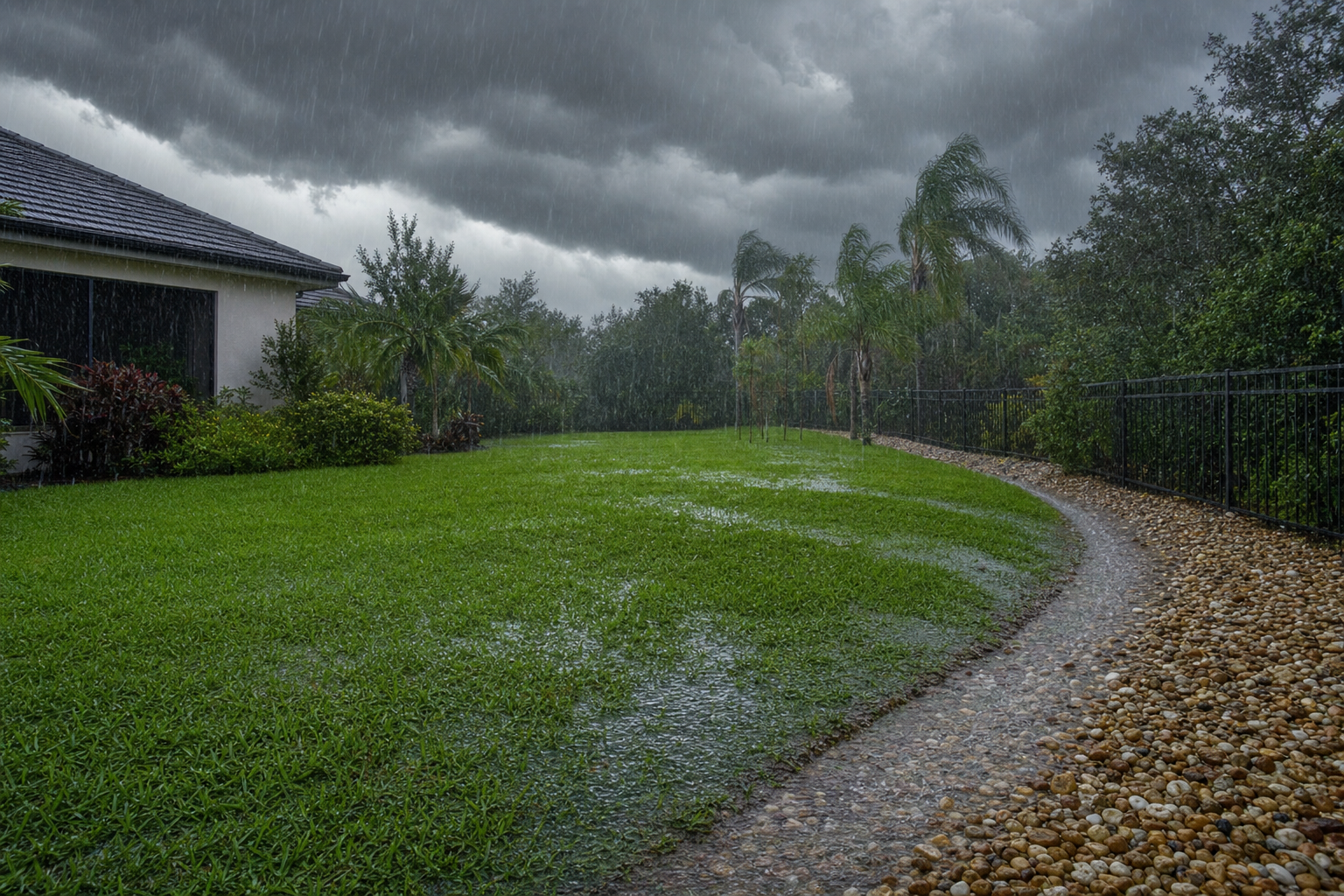
If you’ve lived in Sarasota for more than one summer, you already know what the afternoon storms feel like. By June, daily pop-up thunderstorms can drop an inch or more of rain in under 30 minutes. Multiply that by four months and you have a landscape under serious seasonal stress — especially if the drainage on your property isn’t up to the task.
The good news is that drainage problems are almost always solvable. The key is addressing them before rainy season begins, not after the water is already pooling against your foundation or flooding your beds. Here’s what to look for and what to do about it.
Why Sarasota Properties Are Prone to Drainage Problems
Southwest Florida’s flat topography and clay-heavy subsoil layers create perfect conditions for standing water. Unlike the deep, porous sandy soils of Central Florida, many Sarasota lots sit on a mix of sandy loam over poorly draining hardpan. Add a finished grade that’s settled over time — a common issue on homes more than 10–15 years old — and water has nowhere natural to go.
Development patterns make this worse. Neighboring lots with higher grades, driveways that channel runoff, and neighborhood storm drains that back up during peak storms all contribute to water ending up in your yard regardless of how your own property is graded.
Warning Signs to Check Before June
Walk your property slowly after the next heavy rain (or turn on your irrigation and watch for 20 minutes). Look for:
- Standing water that doesn’t drain within 24 hours of rain
- Low spots in the lawn, especially near the foundation or bed edges
- Mulch washing out of beds during heavy rainfall
- Erosion channels or bare soil streaks where water is moving
- Water staining or efflorescence on foundation walls or stem walls
- Consistently soggy turf that never fully dries between rains
- Root rot or die-off in ornamental beds that were healthy before rainy season
Any of these signals a drainage problem worth addressing. They won’t resolve on their own, and each rainy season that passes without a fix compounds the damage to your soil structure, plant roots, and — eventually — your home.
French Drains: The Most Effective Fix for Most Properties
A French drain is a trench filled with gravel and perforated pipe that collects subsurface water and carries it away from problem areas to a suitable outlet — a street swale, a dry well, or the rear of the property. Done correctly, a French drain is virtually invisible once the ground settles and turf regrows over it, and it handles an enormous volume of water passively with no maintenance required.
French drains are the solution we install most often for Sarasota homeowners, and for good reason: they’re permanently effective, unobtrusive, and address the root cause of the problem rather than just managing symptoms. A properly placed French drain next to a foundation can eliminate years of water intrusion risk in a single installation.
What a French drain installation involves
- Assessment of water flow patterns and existing grade
- Trenching (typically 12–18 inches deep, 12 inches wide) along the drainage path
- Lining with landscape fabric to prevent sediment intrusion
- Filling with washed gravel, setting perforated pipe at the correct slope
- Covering with river rock or turf depending on aesthetic preference
- Connecting to a discharge point that won’t create a problem for neighboring properties
Re-Grading: When the Land Itself Needs Correction
If your yard has developed low spots or areas where the grade slopes toward the house rather than away from it, no drain can fully compensate. The fundamental fix is re-grading — reshaping the soil surface so that water naturally flows away from structures and toward appropriate drainage outlets.
The standard code guidance is for finished grade to slope at least 6 inches over the first 10 feet away from any structure. Many older Sarasota homes have settled well below this minimum, and the result is visible as chronic dampness on stem walls or foundation edges.
We’ve seen foundation-adjacent moisture issues resolve completely after a proper re-grade — without installing a single piece of drain pipe. Sometimes the simplest fix is just moving dirt.
Protecting Your Beds and Plantings
Ornamental beds are especially vulnerable during rainy season. Several approaches help keep them healthy through the wet months:
- Mulch depth and retention: Fresh mulch at 2–3 inches deep (not more) slows erosion and moderates soil moisture. Avoid mulch volcanoes around plant bases — they trap moisture against stems and invite rot. Install steel edging or concrete edging to hold mulch in during heavy rainfall.
- Raised bed edges: Beds that sit slightly higher than the surrounding turf shed water more readily than sunken or flush beds. If your beds have settled low, a bed renovation before June is well worth the investment.
- Drip irrigation suspension: If your irrigation system has drip zones serving ornamental beds, turn them off entirely from June through September. The rain will more than compensate, and running drip in those conditions creates the root rot and fungal issues that most people blame on pests.
Protecting Your Foundation
This is where drainage problems move from annoying to expensive. Water that consistently pools against a home’s foundation doesn’t just wet the soil — it creates hydrostatic pressure against stem walls and block foundations, increases the risk of termite activity in damp wood, and eventually causes cracking and efflorescence that becomes costly to remediate.
The combination of correct grade, gutters that discharge water at least 5 feet from the house, and a French drain along any foundation edge that has consistent moisture issues is the gold standard for foundation protection in our climate. If you’ve been noticing moisture around your slab or stem wall, please don’t wait for another summer to pass before addressing it.
When to Act
March through May is the ideal window to address drainage on your property. The ground is dry enough to work efficiently, and installations have time to settle before the heavy rains begin. Once June hits and the afternoon storms start, scheduling drainage work becomes harder and the ground conditions make it more challenging to achieve the precision a good French drain installation requires.
Blue Stream installs French drains and performs re-grading across Sarasota, Venice, Lakewood Ranch, Palmetto, and surrounding communities. If you’ve been putting off a drainage fix, the calendar is telling you now is the right time.