
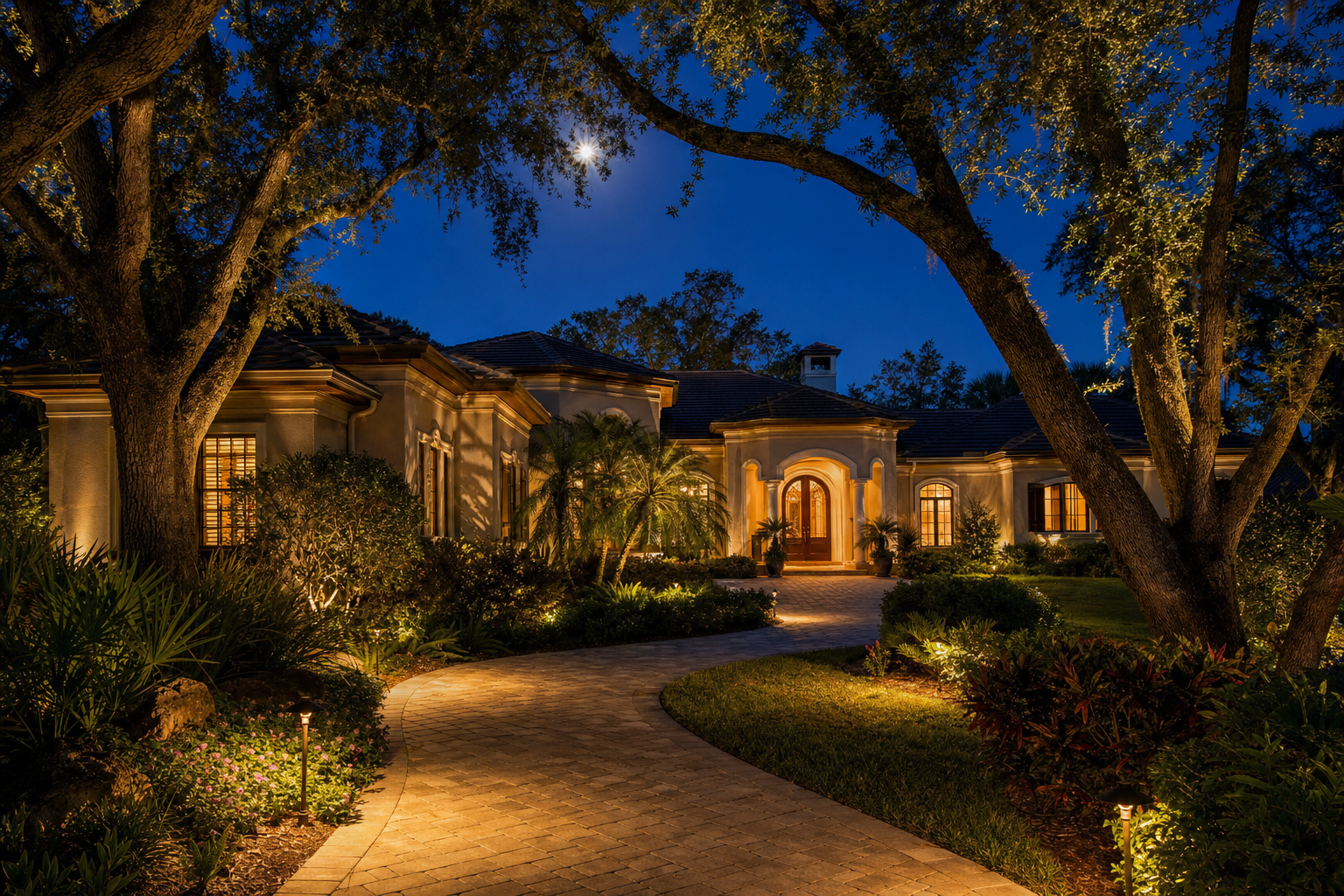
There’s a moment most Sarasota homeowners experience for the first time after a professional landscape lighting installation: you pull into the driveway at 8 p.m. and your home looks completely transformed. Palms glowing from below. A pathway bathed in soft warm light. The house itself lit like architecture rather than a dark box.
That kind of impact doesn’t require a massive budget, but it does require knowing which fixtures do what, how the systems are designed, and how to keep them running in Florida’s demanding climate. This guide covers everything you need.
Why Low-Voltage Landscape Lighting Is the Right Choice
All professional outdoor landscape lighting today is low-voltage — typically 12V systems fed by a transformer that plugs into a standard outdoor outlet. This distinguishes it from line-voltage (120V) systems, which require a licensed electrician for every fixture adjustment and carry real shock risk in wet environments.
Low-voltage systems are safe to handle, easy to adjust or expand, and remarkably energy-efficient. Modern LED fixtures consume as little as 2–5 watts each. A 20-fixture system running 6 hours per night costs roughly $3–5 per month in electricity. By comparison, the same effect with older halogen fixtures would cost 7–10 times more to run.
The Main Fixture Types and What They Do
Path and area lights
Short-staked fixtures that cast a downward pool of light onto walkways, driveways, and lawn edges. They define safe routes at night and are usually the first fixtures homeowners think of. The key design principle: space them for rhythm and overlap, not maximum coverage. Lights every 8–10 feet typically look better than lights every 4 feet at full blaze.
Uplights
In-ground or surface-mounted fixtures that point upward into trees, palms, or architectural features. Uplighting is the most dramatic technique in the toolkit. A single well-aimed uplight at the base of a Washingtonia palm can elevate the entire front of a home. Position uplights tight to the trunk and angled at about 45–60 degrees for the best spread of light through the canopy.
Accent and spotlights
Adjustable above-grade fixtures on stakes or surface mounts. Use them on specimen plants, sculptures, entry columns, or the façade of the home itself. Unlike uplights (which are typically buried flush), accent lights can be repositioned as your landscape grows and changes — a meaningful advantage in Florida, where plants mature quickly.
Step and hardscape lights
Recessed into risers, retaining walls, or dock edges. Essential for safety on multi-level outdoor living spaces, and visually striking when done well. They add depth and dimension to hardscape that path lights alone can’t achieve.
Downlights and moonlighting
Fixtures mounted high in mature tree canopies to cast a dappled, moonlike glow onto the ground below. Moonlighting is subtler and more naturalistic than uplighting — a sophisticated effect that works especially well on large oak canopies or spreading banyan-style trees.
Safety and Security Benefits
Beyond aesthetics, a well-lit landscape is a meaningfully safer property. Research consistently shows that well-lit homes are less attractive targets for opportunistic intrusion. Lighting the perimeter and entry points — gates, side yards, the garage side of the house — eliminates the dark zones that criminals depend on.
For families with children, seniors, or frequent outdoor entertaining, lit pathways, steps, and pool surrounds dramatically reduce trip-and-fall risk. Florida’s outdoor lifestyle means that people are regularly navigating properties after dark, and it’s easy to underestimate how much that matters until there’s an incident.
Well-placed lighting isn’t just beautiful — it’s one of the most cost-effective home safety upgrades available, and unlike an alarm system, it improves your property’s appearance at the same time.
Design Principles That Make a Difference
Professional lighting designers follow a few core principles that separate polished results from haphazard ones:
- Layer your light sources. A mix of uplights, path lights, and accent fixtures creates depth. A yard lit only with path lights looks flat; one lit only with uplights lacks ground-level warmth.
- Choose warm color temperatures. For residential landscapes, 2700K–3000K (warm white) almost always outperforms cool or daylight-range LEDs. Warm tones complement Florida foliage, stone, and stucco better than blue-white light.
- Light the object, not the fixture. Fixtures should be invisible in the final result. The lit palm is the feature; the uplight housing is the tool. If a fixture is visible and bright from normal viewing angles, it’s aimed wrong.
- Build in zones. A transformer with multiple zones lets you control front, back, pool, and path lights independently — useful for different times of night, entertainment modes, and security settings.
Maintaining Landscape Lighting in Florida’s Climate
Florida is hard on outdoor fixtures. Salt air near the coast, intense UV, soil moisture, and afternoon thunderstorms all degrade equipment faster than in northern climates. A few maintenance practices keep systems running at their best:
- Use quality fixtures from the start. Brass, copper, and high-grade aluminum housings outlast cheap zinc or plastic fixtures by a decade or more. The upfront cost difference is real, but so is the longevity.
- Check and adjust uplights seasonally. Fast-growing palms and tropicals can shift the ideal aim of a fixture within a single growing season. A twice-yearly walk-around to aim and angle keeps effects looking intentional.
- Inspect transformer connections annually. Loose or corroded wire connections at the transformer are the most common cause of zone failures. Clean connections and re-torqued terminals take minutes and prevent bigger issues.
- Replace bulbs in matched batches. Even with LED fixtures, color rendering can shift subtly between production batches. If you’re replacing bulbs, do an entire zone at once to maintain consistency.
Curb Appeal and Home Value
Appraisers and real estate agents consistently cite exterior lighting as a high-ROI home improvement, and Sarasota’s luxury home market is no exception. Buyers viewing a home at dusk — which is common at evening open houses — form strong first impressions before they’ve even opened the front door.
A professionally designed lighting system signals property maintenance, attention to detail, and a home that has been genuinely cared for. That perception has real value in competitive neighborhoods from Palmer Ranch to Lakewood Ranch to the barrier islands.