
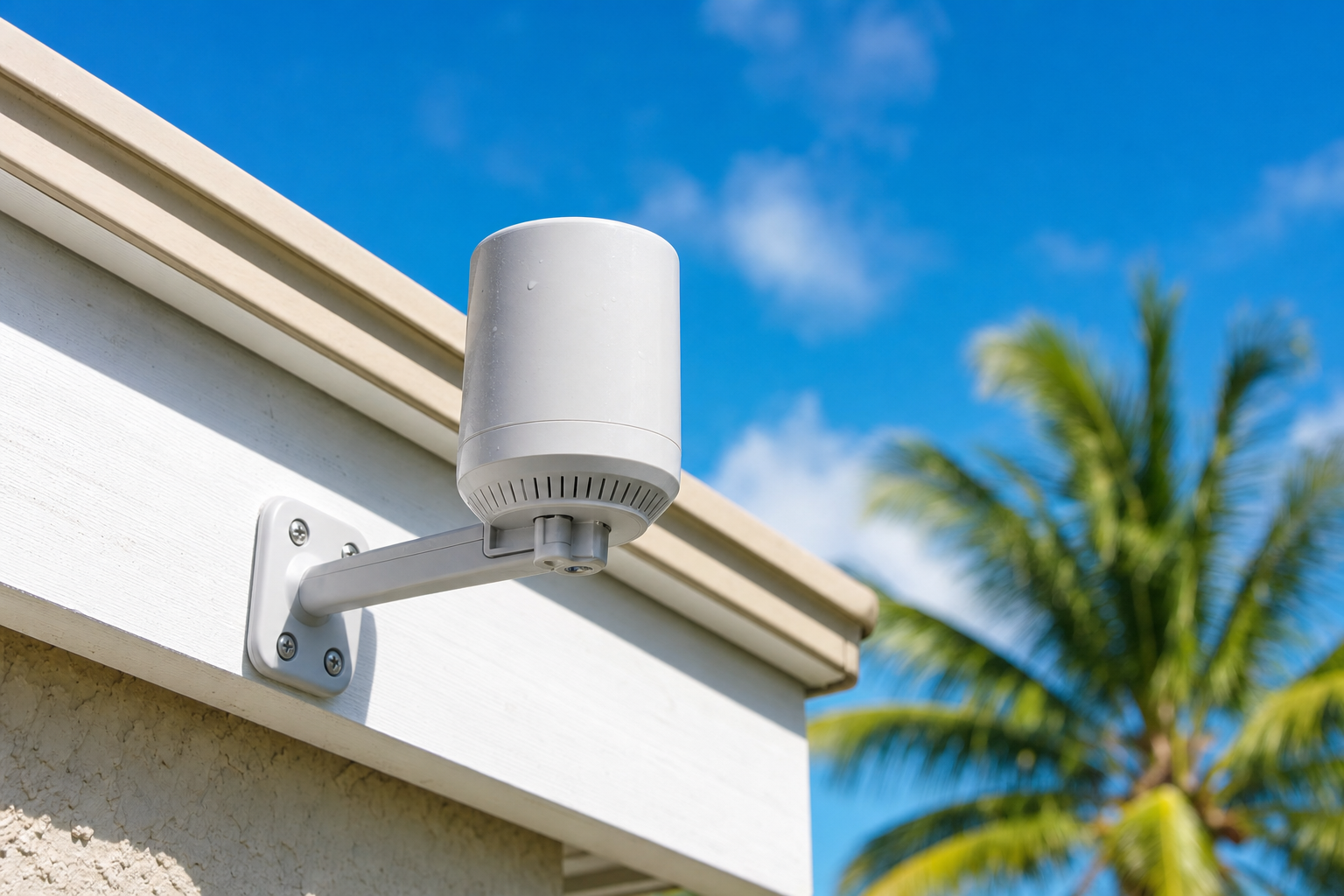
Here’s a question most Sarasota homeowners can’t answer with confidence: Does your rain sensor actually work?
Not “does it exist” — but does it actually interrupt your irrigation system when it’s supposed to? If you don’t know, there’s a reasonable chance the answer is no. And in 2026, with Sarasota County issuing irrigation citations without warning, a non-functioning sensor isn’t just a waste of water — it’s a liability.
What Florida Law Requires
Florida Statute § 373.62 has required functioning rain sensor override devices on all automatic irrigation systems since 1991. The law applies to every home and commercial property with an automated irrigation system in the state — no exceptions.
A compliant system must have one of the following:
- A rain sensor (wireless or wired) that shuts off the system after a set amount of rainfall
- A soil moisture sensor that prevents irrigation when the soil is already at target moisture
- An ET-based smart controller that automatically adjusts schedules based on local weather data
Why So Many Sensors Fail (and Nobody Notices)
Rain sensors fail for several reasons — and because most systems run in the middle of the night, the failure often goes completely unnoticed:
- Disc expansion sensors (the most common type) use cork discs that expand when wet. Over time, the discs dry out, crack, or get compressed and no longer expand enough to trigger the shutoff.
- Sensor bypass switches — many controller panels have a manual bypass switch. Homeowners or contractors often switch it to “bypass” during dry season and forget to switch it back.
- Improper placement — sensors installed under roof overhangs, dense tree canopy, or other sheltered spots may not receive enough rainfall to trigger properly.
- Corrosion and electrical issues — wired sensors degrade over time, especially in Sarasota’s salt air environment.
How to Test Your Sensor in 60 Seconds
- Locate your rain sensor (usually mounted on a fascia board, fence, or gutter bracket in an open area)
- Check your controller panel — make sure the bypass switch is set to “active” (not “bypass”)
- Hold a cup or hose near the sensor until it’s wet
- Within 30–60 seconds, your controller should show a “sensor active” or “rain delay” indicator, and the next scheduled cycle should be suppressed
If nothing happens, your sensor needs service or replacement.