
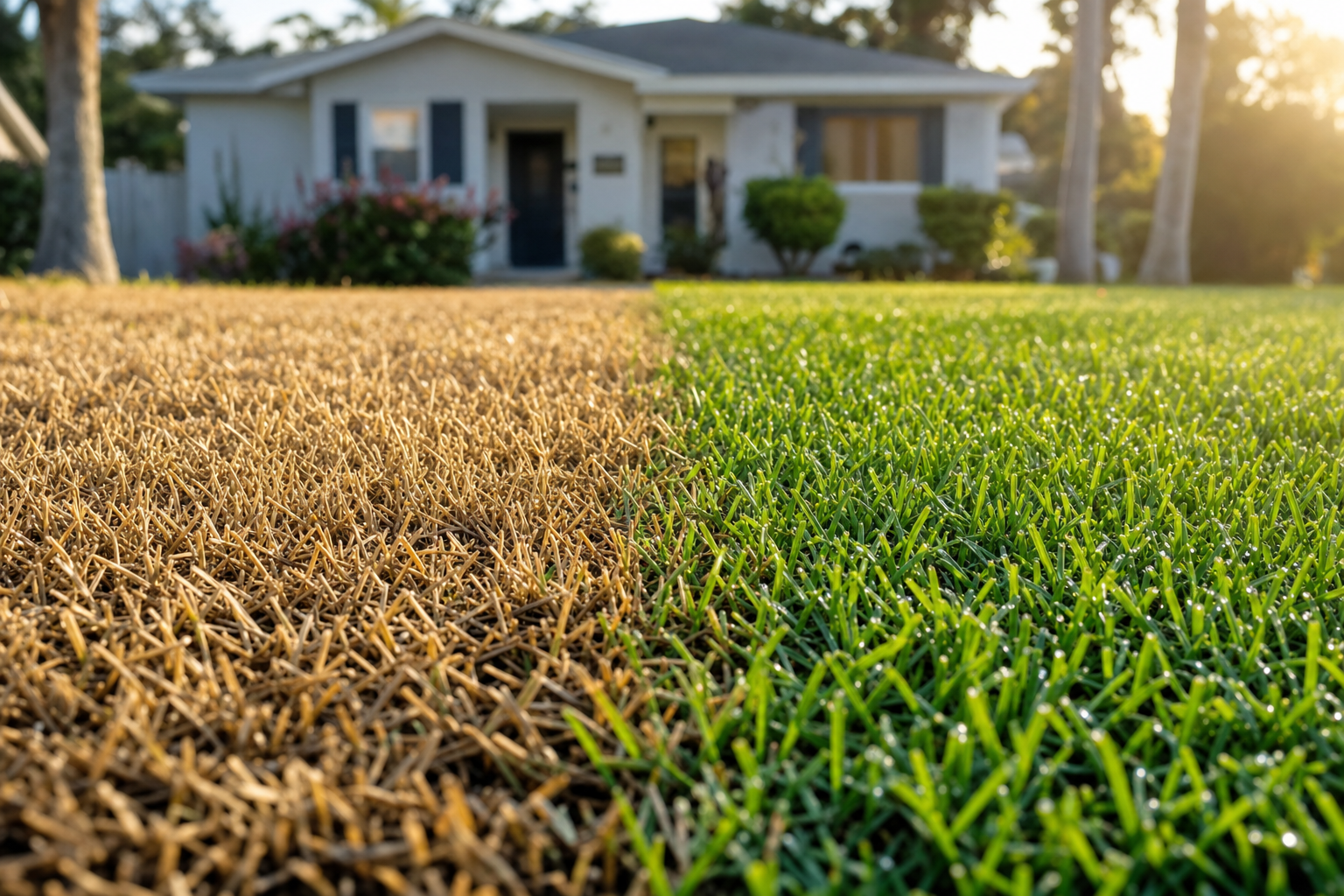
Drive through almost any Sarasota neighborhood in mid-2026 and you’ll see the same thing: brown patches, stressed St. Augustine, dried-out shrubs, and confused homeowners wondering if their lawn is dead or just dormant.
Here’s the good news: most lawns in Sarasota are dormant, not dead — and with the right recovery strategy, you can bring yours back once the rainy season arrives.
Why Florida Lawns Go Brown During Drought
St. Augustine grass — by far the most common lawn turf in Sarasota — naturally goes dormant when it’s deprived of water for extended periods. Dormancy is a survival mechanism: the grass pulls water from its blades down into the root system to keep the crown alive. Brown blades don’t necessarily mean dead grass.
How do you know if your lawn is dormant vs. dead? Try the tug test: grab a handful of brown grass and pull. If it resists and the roots hold, it’s likely dormant. If it pulls out easily with no resistance, those sections may be gone.
What You Should NOT Do Right Now
- Don’t fertilize a drought-stressed lawn. Fertilizer pushes new growth that the plant can’t support without adequate water — and it increases disease susceptibility.
- Don’t scalp or over-mow. Keep mowing heights higher than normal (3.5–4 inches for St. Augustine) to reduce moisture loss from the soil.
- Don’t overwater on your one permitted day. Deep, infrequent watering is far more effective than frequent shallow watering. One long watering cycle gets moisture to the root zone. Multiple short cycles just evaporate.
What You Should Do Instead
- Mulch your plant beds — 3 to 4 inches of mulch retains soil moisture, lowers soil temperature, and dramatically reduces water loss between permitted watering days.
- Check your irrigation zones — make sure every zone is reaching its intended area with no clogged heads, misdirected sprays, or broken rotors.
- Adjust your run times for depth — aim for ¾ inch of water per application. Use the tuna can test: place empty tuna cans around each zone and run it until they contain ¾ inch of water.
- Consider a dormant lawn treatment — some Sarasota lawn care providers offer drought-specific granular applications that support root health without pushing leaf growth.
When Will Recovery Happen?
Florida’s wet season typically begins in late June and runs through September, bringing daily afternoon thunderstorms that can deliver several inches per week. Most dormant St. Augustine lawns recover fully within 2–4 weeks of consistent rainfall — provided the root system is intact.