
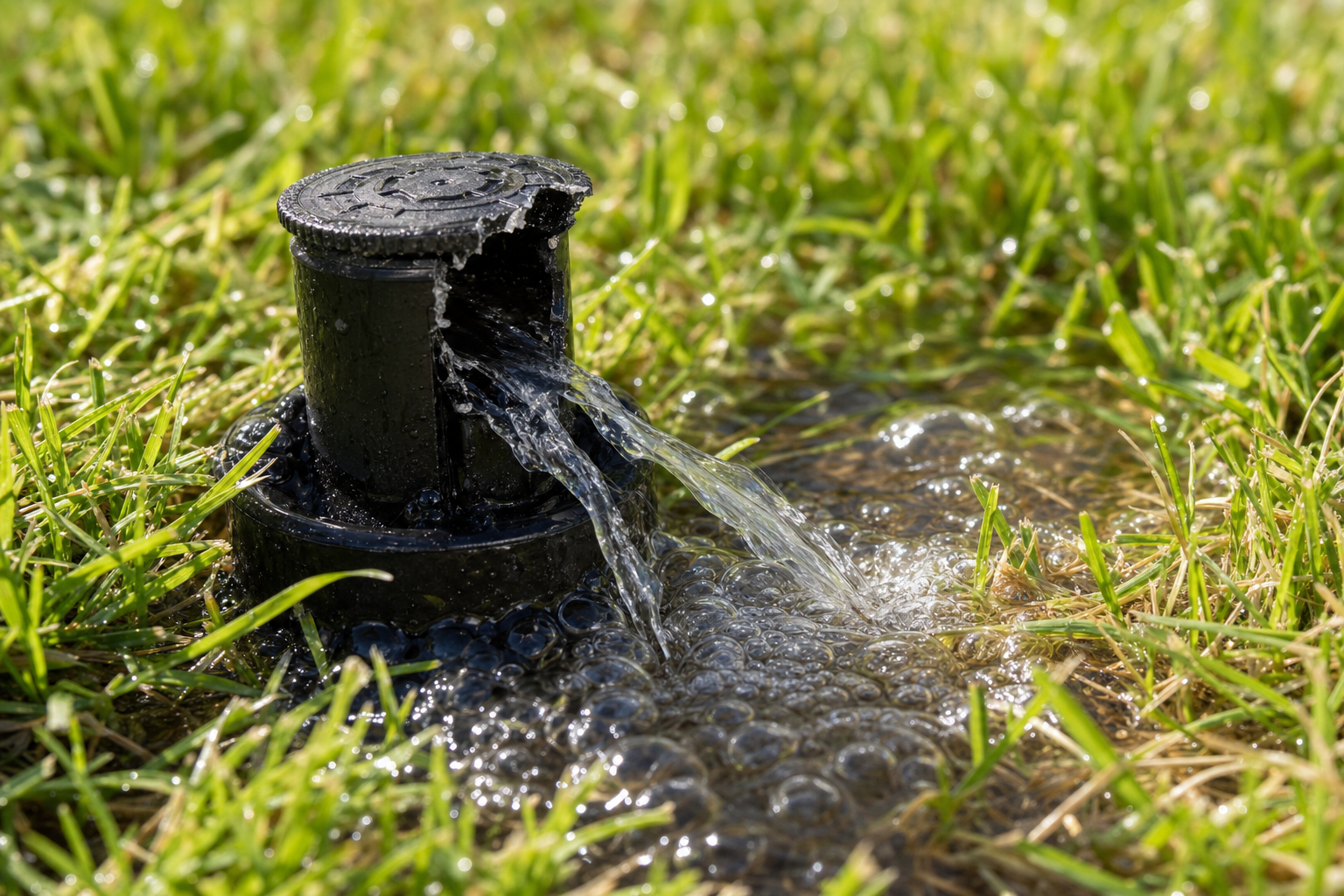
Irrigation problems are almost always cheaper to fix when caught early. A $15 sprinkler head replacement becomes a $500 landscape restoration if it’s been silently underwatering a planting bed all season. Here’s how to spot the most common irrigation issues before they become expensive.
Visual Signs to Look for After a Watering Cycle
Walk your property within 30 minutes after an irrigation cycle ends and look for:
Wet spots where there shouldn’t be any
- Water pooling near a head base (usually a cracked casing or worn seal)
- A wet area along a straight line in your lawn (underground mainline leak)
- Water seeping up near the valve box (valve failure or stuck solenoid)
Dry spots where there should be coverage
- Brown patches in otherwise green turf (blocked or misdirected head)
- Wilting plants in a bed that should be on drip irrigation
- Areas more than 12 inches from the nearest head that consistently look dry
Improper spray patterns
- A head spraying at an angle instead of straight up (tilted from mowing or settling)
- Mist instead of a clean spray pattern (clogged nozzle)
- A head spinning but not stopping at its programmed arc (worn gear in rotor)
The Tuna Can Test for Coverage and Rate
This is the simplest DIY irrigation audit you can run:
- Place several empty tuna cans (same size) around a zone — spread them across the zone, not just near heads
- Run the zone for its normal cycle duration
- Measure the water in each can
If the amounts vary significantly (more than 25%), you have distribution uniformity problems. If it takes more than 30 minutes to collect ¾ inch in a spray zone, your heads are underperforming.
Seasonal Vulnerabilities in Sarasota
- After drought seasons: Pipe joints can crack as soil shrinks and shifts during extended dry periods. The first cycles of wet season are when underground leaks often show up.
- After hurricanes or high winds: Heads can be knocked out of alignment; debris can clog nozzles.
- After lawn mowing: Heads can be sheared off if they don’t retract fully, or mower decks can crack casings.
When to Call a Professional
Call Blue Stream when:
- You find a wet spot in your lawn that doesn’t dry up between watering days (active underground leak)
- A zone doesn’t come on or doesn’t turn off (valve problem)
- Your water bill spikes without explanation
- You can’t get your controller to respond to programming changes